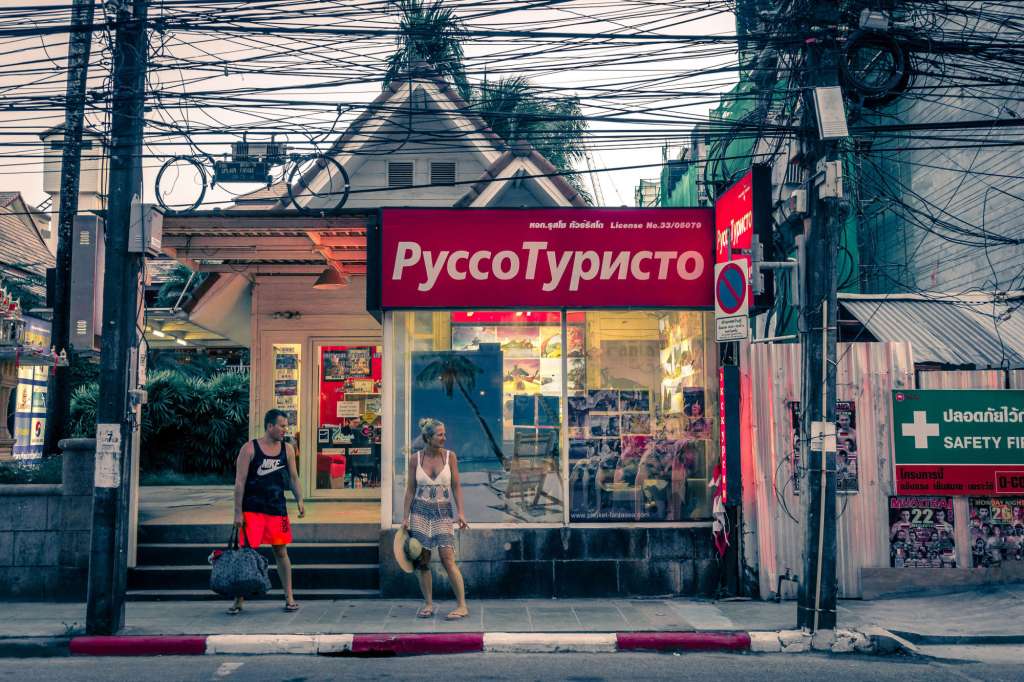
While in Phuket, I noticed many Russian-speaking vacationers, even Russian signage and flags welcoming them into Phuket stores and restaurants. When traveling abroad, you encounter all kinds of languages, dress, and customs. So, I wasn’t surprised to hear and see Russians, but I was curious about the turnout of Russians choosing to vacation in Phuket of all places. I estimate at least half of the hotel guests were from Russia. And if I noticed them, I’m sure they noticed a dozen American and Canadian gay men hanging out together at the hotel pool and restaurant.
I later learned that Thailand is one of the few countries that allows easy entry to Russian citizens. So, they come here for a holiday in droves. Many Russians now own businesses here, supported by a constant influx of loyal Russian visitors. Russians come here to escape the war; some are here to avoid the draft, and others are here to take advantage of Thailand’s liberal immigration, driving up rental and condo prices across the region. One news outlet called it an invasion, publishing that over half a million wealthy Russians will descend on Thai beaches this winter.
I’m starting to lean toward my initial fear that we were, in fact, vacationing with the enemy.
Considering the state of affairs between our two countries and the war in Ukraine, I couldn’t help but feel a certain level of discomfort. Was I vacationing with the enemy? What did they think of me as an American…as a gay man? (Being gay in Russia is illegal — well, at least talking about it or mentioning it is.) Did they feel condemnation or hate toward me? Did they blame me for the sanctions burdening their economy and families? I wondered if they had been impacted by the war? Have American weapons and training killed a loved one? Or, at some level, do they understand America’s position against Putin and his unprovoked invasion of the sovereign state of Ukraine? Maybe they don’t blame us, even have some level of understanding why these drastic measures were necessary? Perhaps they even secretly support sanctions and slowing down the Putin regime? But, considering the cost of vacationing and the rates at the hotel, all these families clearly have disposable income, which I can’t help but deduce means they’re affluent, which I assume means they work for or own businesses allowed to exist or are connected to the Putin regime. Can Russians achieve middle or upper class without being loyal to Putin? I must plead ignorance in this matter, but I’m starting to lean toward my initial fear that we were, in fact, vacationing with the enemy.
The intellectually curious part of me wanted to strike up a conversation with one of the Russian guests to ask those questions. What do they believe and understand? What was an “everyday” Russian’s view on Ukraine, America, and Putin? But, playing out that conversation, I knew it would be a fruitless or even dangerous exercise. I can’t even ask fellow Americans their thoughts on certain divisive issues. Everyone, including my Russian vacationers, is so divided and entrenched in the information in our echo chambers that it’s best to avoid the confrontation; it’s better to not know. It’s sad to think that talking things out is over.
So here we are, vacationing with perceived enemies abroad and living among perceived enemies at home. This feeling should cause great concern for all sides of these national and international conflicts.
The following day, I was one of the first of our group to go down to the hotel’s breakfast buffet. I ordered an omelet, selected a large Americano coffee on the espresso machine, and sat down in the open-air dining area, which ran parallel to a lovely water feature in the center of the hotel. A large, burly man sat down across from me. In a thunderous, resounding, stern Russian voice, I am reminded of the Russian Ambassador character in the movie “Crimson Tide.” He asked the dining room attendant for additional place settings. Shortly after, a beautiful young woman joined him. The two of them greeted one another and began a lively conversation. Jumping to stereotypical and dramatic conclusions, he must have been a Russian oligarch; she was his mistress. I continued eating breakfast as fellow travel companions joined me at my table. We chatted about the previous evening’s activities, how we slept, our thoughts about dinner, etc. I looked across the way at the assumed oligarch and saw that he was now joined by an older woman carrying a small toddler. Ahh, this was his wife, the beautiful woman, his daughter, and the little baby, his grandchild. The loud and stern voice switched off and was replaced with high-pitched one mumbling sweet baby talk as he nuzzled the babe and kissed its little forehead.
I wasn’t seeing a tawdry Russian Oligarch’s affair; I was witnessing a typical familial scene of extended families coming together to bond, rest, and relax on holiday.
I was foolish about some of the conclusions drawn about the Russian hotel guests. Although we may be enemies on the battlefield, we still have common ground: we both have families we love and wish to protect. How do we leverage our common ground to resolve our conflicts and live in peace? If we can step outside our echo chambers, speak and listen to one another, maybe pause some beliefs we’re told to fight for without a complete and balanced understanding, and try to seek our own experience, we could bring some rationality to the table, meet with open minds and hearts and find that were really do have more in common than we don’t.


 Around the World with Cal
Leave a comment