
The title of this article may be harsh; it’s intentionally provocative. But there is an element of truth here, and it has implications for the home front, so hear me out.
The first thing you notice about New Zealanders is their laid-back attitude and approachability. They’re the types who never meet a stranger and always have time for a quick chat or to give helpful advice. They’re gabby, inquisitive, and sincere, similar to their Australian cousins but perhaps a notch higher, especially when enforcing work-life boundaries.
I started noticing something different in the evenings. Unlike Melbourne, restaurants start closing at 9 p.m., and there’s a noticeable thinning of sidewalk traffic and chatter as the clock ticks past sunset, around 8:30 p.m. When it gets dark, everything shuts down. I learned to be butt-in-seat, ordering dinner by 8 p.m., or there’s no supper. Even greasy pub kitchens close early, serving only drinks until 11 p.m. Nightclubs are all left standing past this time.

On my first evening in Auckland, my body was still 2 hours behind Melbourne time, so I got hungry after 8 p.m. When I found a spot with several eateries, their kitchens were all closed. And there was no soft close about it. When 8:50 p.m. came, placards were placed out front sternly proclaiming “KITCHEN CLOSED.” People were still sitting under canopies, finishing meals, and ordering more wine, but there was no more food coming, that was certain.
“Kiwi workers seem obsessed with quitting time… Government regulations further reinforce the behavior.”
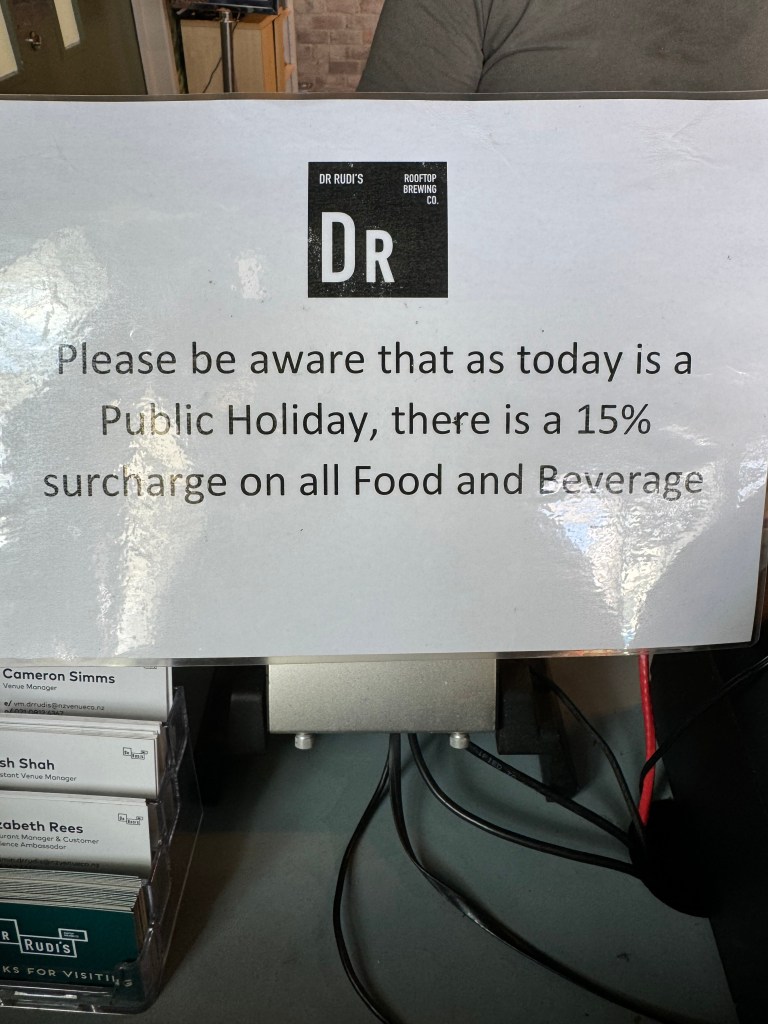
Kiwi workers seem obsessed with quitting time. Store owners don’t have a say; otherwise, owners wouldn’t want to turn away revenue. Even with streets full of hungry tourists, workers demand employers value their work/life balance over profit. Government regulations further reinforce the behavior. If employees work on Sundays or holidays, a 5-15% surcharge is added to their pay and your bill. On more than one occasion, I heard bus drivers, waiters, and store clerks excuse themselves from work to “respect regulations.”
I hired a tour company for a day trip to Rotorua. Admittedly, the journey to and from was a full 12-hour day. But, for the driver, there were hours of non-driving time when he could lounge in A/C comfort while we were sweating our asses off taking pictures of hobbit holes and farting mud. After our last stop, eager to get the three-hour return behind us, we unfortunately encountered road work, delaying our return by 30-40 minutes. As we finally approached the Auckland city limits, the driver announced, “To respect working hour regulations, rather than drop off at your respective hotels, I will do one stop at Cordis Hotel, and you’ll need to find your own transport from there. What would happen if traffic held us up even longer? Would he just drop us off at the city border and say, good luck, everyone! This kind of behavior was common in my experience. Kiwis just don’t give a f***; their primary value is their life, not their job or what their employer or customers think of them. Who can blame them? They’ve stripped all motivation factors from the formula.

Kiwis get paid a healthy minimum wage with government benefits; there’s no tipping here. You pay the amount on the tab, not a penny more. The lack of incentive has drawbacks from a service perspective. When servers have skin in the game, they’ll go the extra mile, selling more to drive revenue and leave customers satisfied, so they kick in an additional 20%. There has been much debate in America over switching to a pay model that is more aligned with the one used in New Zealand. Many progressive American restaurants proudly advertise their livable server wage and no tipping policy. Did their service levels suffer? After my Kiwi service experience, I have grave reservations about the model.
On one of the many Uber rides, I mentioned that things shut down surprisingly early here. Without any prompting, the immigrant driver said, “Oh, Kiwis hate work; they’re lazy as f***. They don’t care about anything but getting their required time in and getting out of there.”
“Kiwis just don’t give a f***, their primary value is their life, not their job or what their employer or customers thinks of them.”
The following day, I heard an opposing perspective. I was waiting for my taxi to change hotels, and the door woman was chatting with me. She said I’m sure you’ve noticed our chill attitude here? I tried to suppress a sarcastic tone and said, “Yes, I sure have.” She said, “Some people think we’re lazy, but we’re just super chill. Do you see us stressed or unhappy, arguing and yelling? No, we’re chill, we roll with it, we take our time and enjoy life. I nodded politely and agreed because what she said was true. People here are happy, content, and focused in the moment. I refrained from saying, “Except at quitting time when the entire country will trample you and your baby as they charge the door.”

So, are Kiwis lazy, chill, or work-life balance champions? Does their independent spirit give them the tenacity to demand fair pay for a day’s work to protect their work-life balance? It raises an important question. Should companies be rewarded with profits for exploiting workers from countries where those protections are not valued? Travel lets you see and experience how different cultures, economies, and policies address these concerns. As a result of these observations, we can make more informed choices about the policies, priorities, and votes we make on the home front.
“As we debate the notion of a ‘work-life balance,’ we may need to evolve into a more inclusive concept: a ‘work-life-service balance’ using a combination of liveable wage and incentive to ensure a content workforce, a business-friendly environment, and happy customers.
Despite occasional frustrations, I found Kiwis content with their way of life. Their “chill” attitude, often mistaken for laziness, is better understood as a dedication to personal well-being. It’s a reminder that happiness isn’t measured by the clock but by the quality of life. However, as I reflect on the less-than-optimal service experiences, it becomes evident that as we debate the notion of a “work-life balance,” we may need to evolve into a more inclusive concept: a “work-life-service balance” using a combination of liveable wage and incentive to ensure a content workforce, a business-friendly environment, and happy customers.

 Around the World with Cal
Leave a comment